
The problem: your bedroom is supposed to be restful, but it feels restless
You’ve asked yourself a version of this question before:
“Why doesn’t my bedroom feel relaxing?”
“What can I put on these walls that won’t make the room feel smaller?”
“Is there such a thing as art that actually helps me sleep better?”
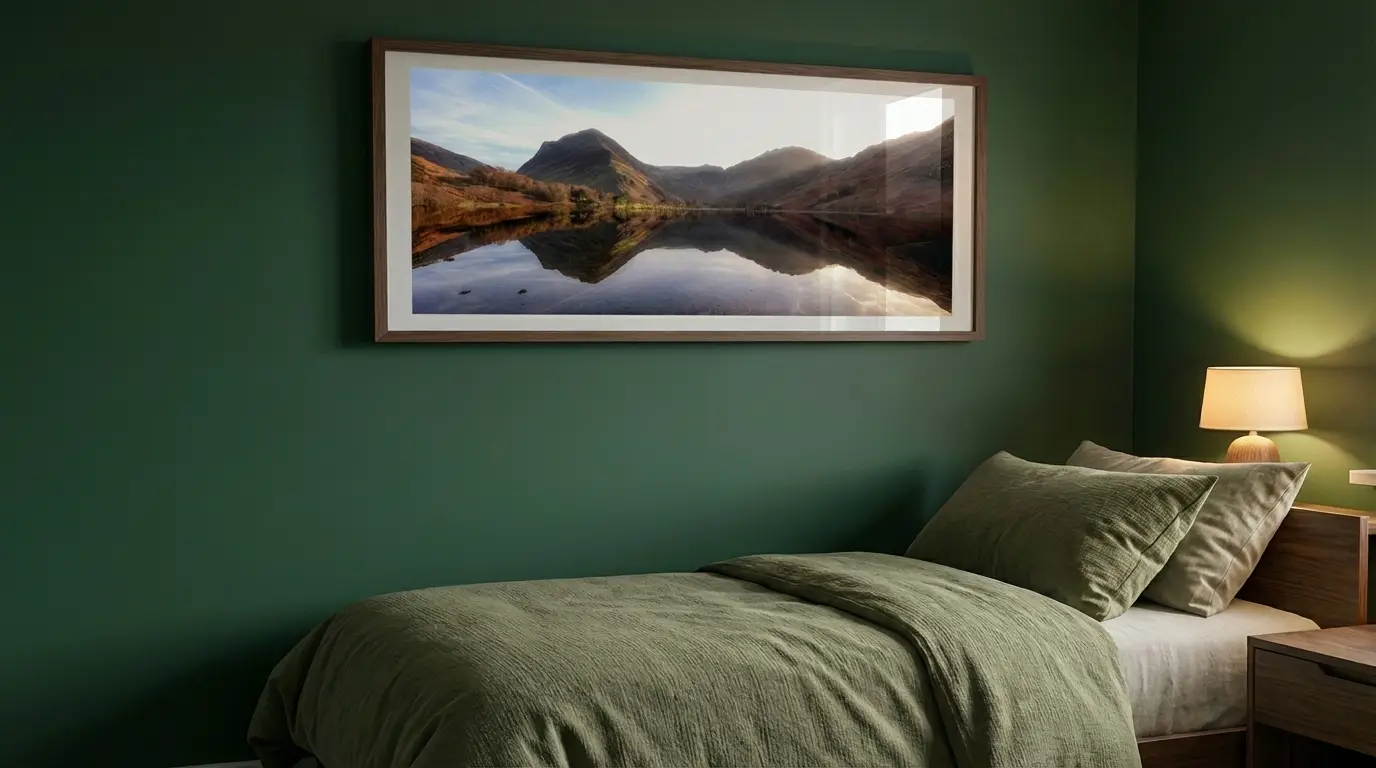
You’re not alone. Most people hang art in their bedroom because they think they should. A blank wall feels unfinished. So they buy whatever is on sale at a home goods store—a generic canvas, a mass-produced print, something with a motivational quote about dreaming big.
And then they wonder why it doesn’t feel right.
The problem isn’t you. The problem is that most art is designed to be looked at, not lived with. It’s chosen for its standalone beauty, not for its psychological effect on a small, intimate space.
According to Neurodecorating®—our methodology that applies cognitive psychology to art selection—the wrong art in a small bedroom can actively work against your rest. The right art can transform the same room into a sanctuary.
This guide will walk you through exactly what to look for, why it works, and four specific printable art downloads you can use today.
Part 1: Why small bedrooms need a different approach to art
Before we talk about specific pieces, let’s understand the psychology of a small space.
The neuroscience of enclosure
When you’re in a small room, your brain is constantly processing boundaries. Your peripheral vision registers the walls, the ceiling, the floor. There’s less “visual white space” for your brain to rest in.
This isn’t inherently bad. Small spaces can feel cosy and safe—like a cocoon. But they can also feel confining and cluttered, depending entirely on what your brain is asked to process within those boundaries.
Here’s the critical insight from Neurodecorating®: every object in a small room is amplified. There’s nowhere for your eye to escape to. So every color, every line, every shape carries more weight than it would in a large, open-plan living area.
The rule for small bedrooms: Choose art that recedes or grounds, not art that shouts.
The Sanctuary-Seeker archetype explained
In the Neurodecorating® framework, we identify four psychological archetypes that determine how art affects you. For a small bedroom, the most relevant archetype is almost always the Sanctuary-Seeker.
| Archetype | Primary Need | Best For | Art Characteristics |
| Sanctuary-Seeker | Calm, restoration, safety | Bedrooms, bathrooms, meditation spaces | Low contrast, organic shapes, calming colors, familiar subjects |
| Idea-Engine | Creativity, focus, productivity | Home offices, studios, creative spaces | Dynamic but not chaotic, movement, flow |
| Deep Thinker | Contemplation, narrative, intellectual stimulation | Studies, libraries, reading nooks | Symbolic, layered, mysterious |
| Curator | Collecting, conversation-starting | Living rooms, galleries, entertainment spaces | Bold, iconic, culturally significant |
If you’re reading this guide, you are likely a Sanctuary-Seeker—or you’re designing a bedroom for one. Your home isn’t just a place to live. It’s a place to recover. And the right art is one of the most effective recovery tools you own.
What a Sanctuary-Seeker’s brain needs
Let me get specific about what your brain is looking for when you walk into a small bedroom after a long day.
1. Low contrast
High-contrast images (pure black next to pure white, jarring color combinations) activate the brain’s orienting response. Your brain essentially says, “Something important just happened—pay attention.” That’s great for a movie poster in a living room. It’s terrible for a bedroom where you’re trying to down-regulate.
2. Organic, flowing shapes
Hard geometry (sharp angles, perfect grids, aggressive lines) signals artificiality and demand. Your brain processes them as “man-made,” which keeps a small part of your attention on analysis. Organic, flowing shapes (curves, fluid forms, natural silhouettes) signal safety and ease.
3. Calming colors
This is personal, but research consistently shows that muted blues, soft greens, warm earth tones, and gentle creams lower heart rate and reduce cortisol. Avoid bright reds, neon colors, and high-saturation primaries.
4. Familiar, grounding subjects
Abstract art can work beautifully for Sanctuary-Seekers, but only if it suggests something familiar (water, leaves, clouds, gentle movement). Completely non-representational abstract art can feel unresolved to a brain seeking safety.
5. Expansive landscapes
A landscape photograph—rolling hills, a calm lake, a misty coastline—creates visual depth. Your brain processes the horizon line and the receding distance, and in that processing, the room itself feels larger. This is the same principle that makes a mirror expand a space, but a landscape adds soft fascination: the gentle, effortless attention we give to nature. Look for horizontal orientation, muted colors, and simple compositions. Avoid dramatic skies or busy foregrounds. For the Sanctuary-Seeker, a landscape doesn’t escape the room—it expands it.
Part 2: Four printable art prints prescribed for your small bedroom
Now let’s get practical. Here are four digital wall art downloads from our collection, each specifically chosen for the Sanctuary-Seeker in a compact space.
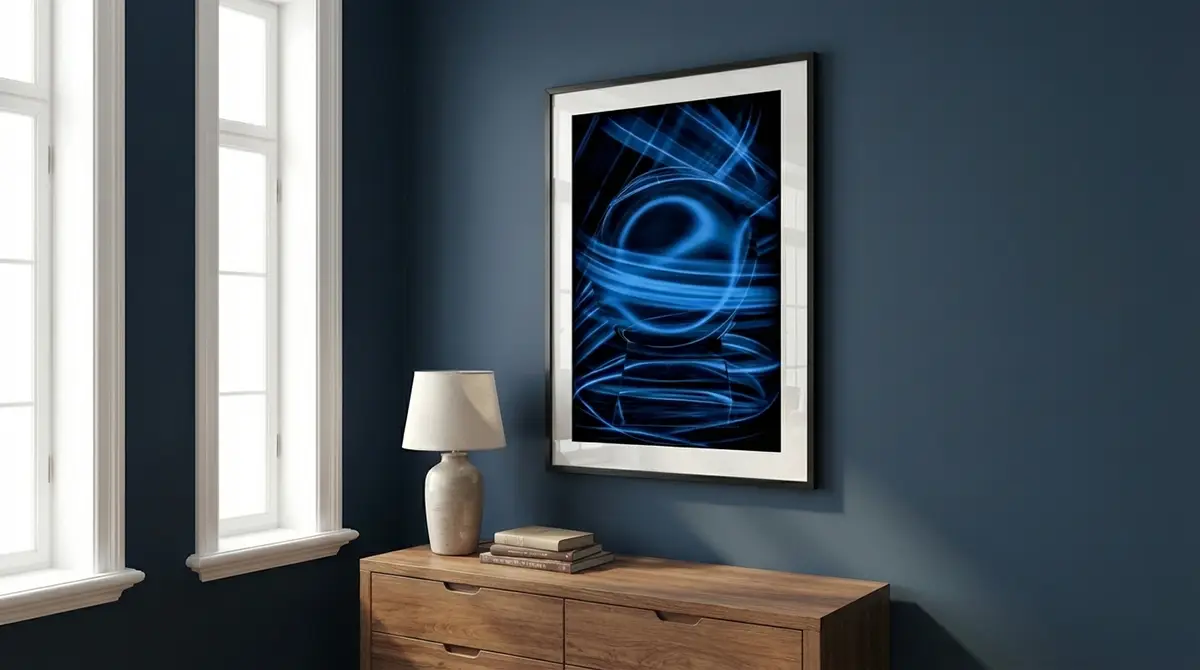
Print #1: “Water” Crystal Ball Abstract by Michael Paul Bennett
Artist: Michael Paul Bennett (UK landscape and abstract photographer)
Style: Abstract photography, fluid light forms
Palette: Deep black background, swirling cobalt and cerulean blues
Best for: The Sanctuary-Seeker who needs a focal point for meditation
Why this print works for a small bedroom
The “Water” print features a luminous blue crystal ball, encircled by swirling beams of light captured through a remarkable photographic process. In a dark studio, Michael used a slow shutter speed while moving a handheld blue light source around the ball—no AI, just pure photographic craft, perfected in Adobe Lightroom.
The result is an image of profound depth. The deep black background creates visual expansion—it doesn’t feel like a solid object on your wall; it feels like a window into somewhere else. This is critical in a small bedroom, where every wall surface is already a boundary.
The swirling blue light has a fluid, watery quality. Your brain processes this as movement without agitation. It’s the same soft fascination you experience watching ripples on a pond or steam rising from a cup of tea.
Neurodecorating® prescription
“This artwork is prescribed for the Sanctuary-Seeker to cultivate a profound sense of peace and mental retreat. The tranquil blues and fluid, watery motifs transform any room into a restorative haven—a place where your nervous system can finally down-regulate after a demanding day.”
Where to place it
- Across from your bed: So it’s the last thing you see before sleep and the first thing you see upon waking
- Size recommendation: 16″ x 24″ or 20″ x 30″ (large enough to be a focal point, not so large that it overwhelms)
- Framing: Simple black or dark wood frame. No ornate detailing.
How to print it
Print on matte fine-art paper to avoid glare. Glossy reflections can be subtly agitating to a Sanctuary-Seeker’s brain.
👉 Download “Water” by Michael Paul Bennett here
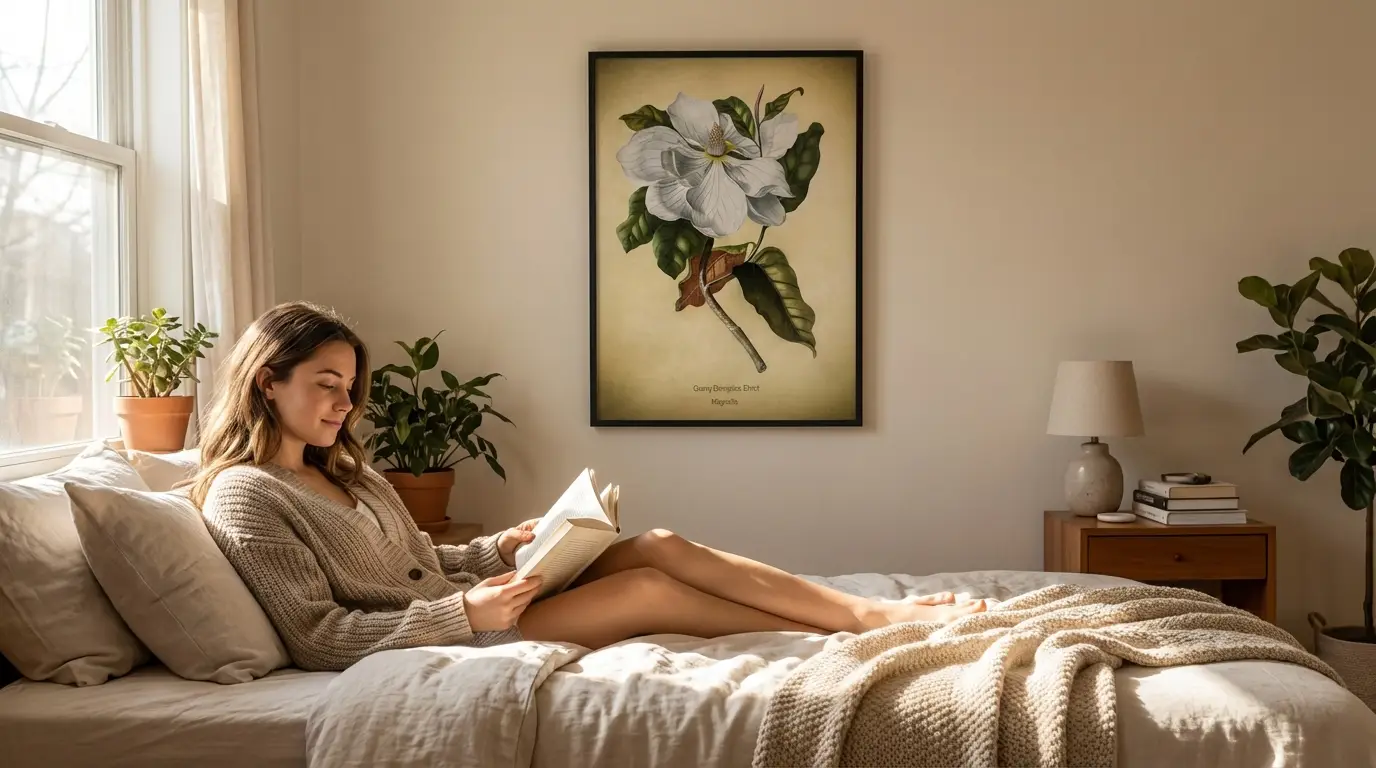
Print #2: “Magnolia” by Georg Dionysius Ehret (Digitally Remastered)
Artist: Georg Dionysius Ehret (1708-1770), renowned botanical artist
Style: Vintage botanical illustration, digitally remastered
Palette: Rich magnolia blooms, lush greens, warm cream background with vintage typography
Best for: The Sanctuary-Seeker who finds peace in natural beauty and historical depth
Why this print works for a small bedroom
Georg Dionysius Ehret was one of the most celebrated botanical artists of the 18th century. His work hangs in the Natural History Museum in London, the Royal Collection, and the world’s finest botanical libraries. But here’s what matters for your small bedroom: his magnolia illustration is a masterclass in ordered tranquility.
The magnolia itself is a flower that has existed for over 20 million years—it predates bees. There’s something deeply grounding about that evolutionary timescale. When you look at a magnolia, your brain is connecting to one of the most ancient and resilient forms of life on Earth. That’s not spiritual woo—it’s evolutionary psychology.
Our digitally remastered version has been meticulously enhanced to showcase rich tones and clarity while preserving the original’s delicate touch. We’ve added a stylish vintage-style background and typographical elements above and below the magnolia art print, creating a sophisticated modern art piece that resonates with both history and contemporary design.
Neurodecorating® prescription
“This artwork is prescribed for the Sanctuary-Seeker who finds restoration in natural beauty and historical continuity. The magnolia’s soft petals and gentle curves invite the eye to rest, not race. The vintage aesthetic signals permanence and tradition—qualities that reassure a nervous system seeking safety. Displayed in a bedroom, it anchors the space with quiet elegance, reminding you that some things endure.”
Where to place it
- Above a small dresser or vanity: The vertical orientation works beautifully in narrower wall spaces
- Beside a window: Natural light will bring out the richness of the magnolia tones
- Size recommendation: A4 (printed at home) up to 25″ x 35″ (professionally printed)
👉 Download the “Magnolia” remastered print here
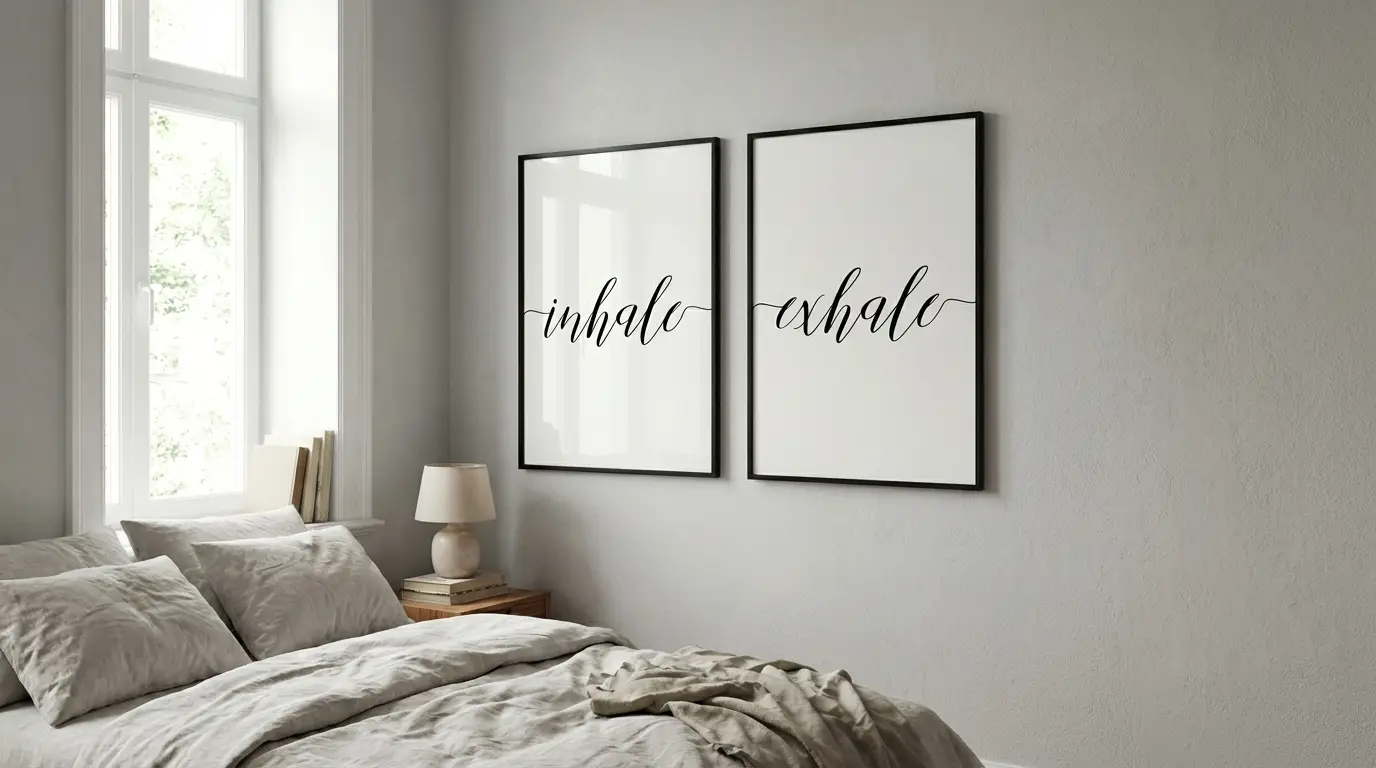
Print #3: “Inhale. Exhale.” Typography Set
Artist: Download Artwork in-house design
Style: Minimalist black and white typography
Palette: Crisp black text on clean white background
Best for: The Sanctuary-Seeker who needs a daily mindfulness trigger
Why this print works for a small bedroom
Sometimes the most powerful art is the simplest. This set of two typography prints—one reading “Inhale,” the other “Exhale”—doesn’t try to impress you with technique or complexity. It simply gives you a command. And that command is exactly what a stressed Sanctuary-Seeker needs.
Here’s the neuroscience: when you glance at a word, your brain activates the concept associated with it, even if you don’t consciously read it. So every time your peripheral vision catches “Inhale. Exhale.”—even while you’re scrolling your phone, even while you’re drifting off to sleep—your brain is subtly reminded to breathe.
And slow, deep breathing is the single most effective way to activate your parasympathetic nervous system (the “rest and digest” mode).
Neurodecorating® prescription
“This artwork is prescribed for the Sanctuary-Seeker as a mindfulness anchor. The minimalist typography invites pause without demanding attention. Placed in a bedroom, it transforms a blank wall into a gentle wellness tool—a visual cue to breathe, settle, and release the day. For the Sanctuary-Seeker who struggles with racing thoughts at bedtime, this piece is a quiet ally.”
Where to place it
- One on each side of the bed: So “Inhale” is to your left and “Exhale” to your right as you lie down
- Above a small reading chair: Where you sit to decompress before sleep
- In a bathroom: If your bedtime routine includes a bath or shower
- Size recommendation: Multiple ratios available (4:5, 5:7, 2:3, 5:4, 7:5, 3:2). A set of small 5″ x 7″ prints can be clustered; larger 16″ x 20″ prints make a bold statement.
👉 Download the “Inhale. Exhale.” typography set here
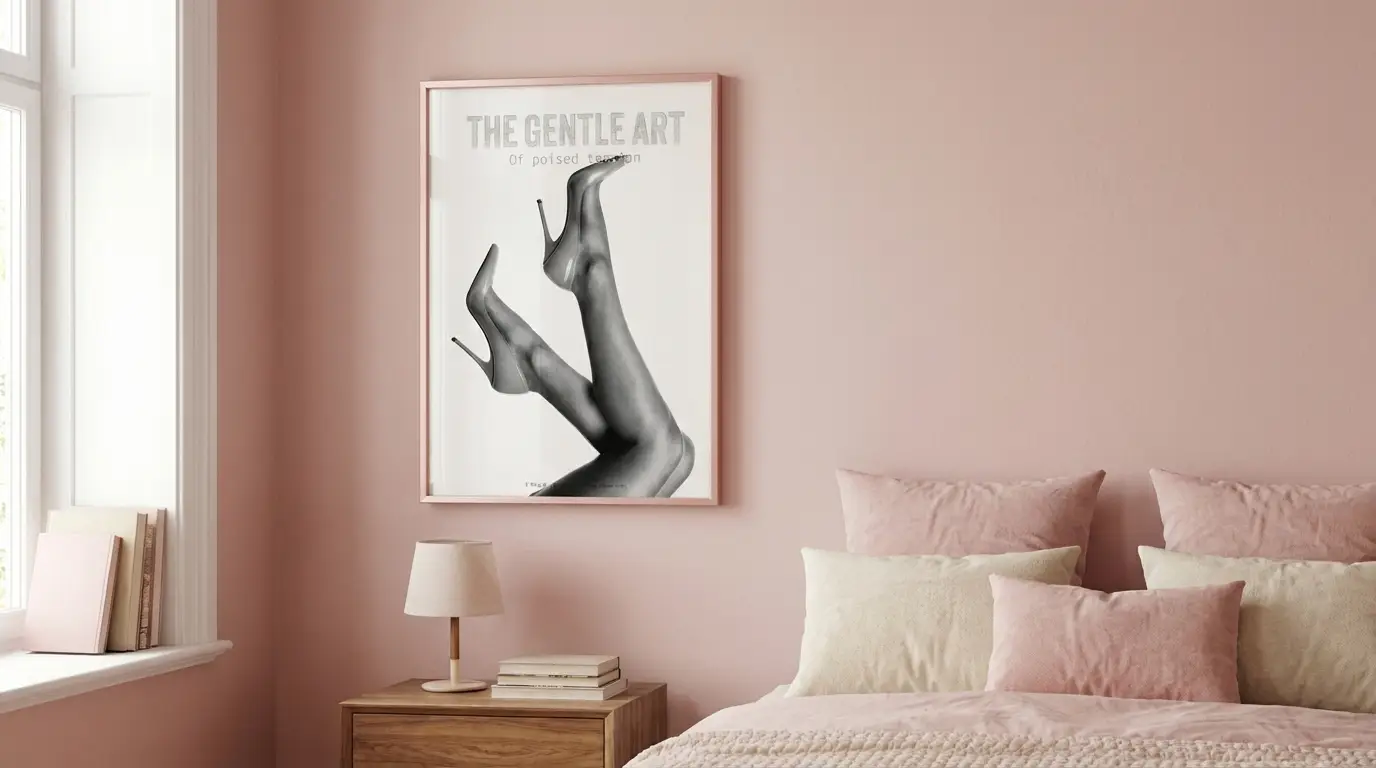
Print #4: “Poised Tension” Minimalist Figure by Rex & Co.
Artist: Rex & Co. (black and white, wit, psychological depth)
Style: Minimalist black and white figure art
Palette: Stark black and white, high contrast but simple composition
Best for: The Sanctuary-Seeker who finds calm in controlled strength and composure
Why this print works for a small bedroom
“Poised Tension” captures a moment of perfect stillness—a figure bent in elegant balance, neither falling nor frozen. It’s a portrait not of a face, but of a state: the psychological moment where calm and potential energy meet.
For a Sanctuary-Seeker, this image is a model. It shows you what composure looks like. Your brain, through mirror neurons, subtly adopts the posture and emotional state it observes. When you glance at this figure—poised, balanced, utterly in control—your own nervous system receives the message: you can be still too.
Unlike the other prints in this guide, “Poised Tension” uses high contrast which we would normally avoid in a small bedroom. However, the simplicity of the composition—just one subject, no background clutter, no additional elements—means the contrast doesn’t become agitation. It becomes focus.
Neurodecorating® prescription
“This artwork is prescribed for the Sanctuary-Seeker who needs a visual anchor for inner calm. The poised figure models composure under pressure, inviting your own nervous system to settle. Displayed in a bedroom, it serves as a quiet reminder that strength and stillness can coexist—and that rest is not weakness.”
Where to place it
- On a wall you see while getting ready for bed: The ritual of preparing for sleep becomes a moment of mindful pause
- Beside a mirror: The figure’s poise reflects back at you as you see yourself
- Size recommendation: 5:7 ratio, printable at A4 (home) up to 25″ x 35″ (professional)
👉 Download “Poised Tension” by Rex & Co. here
Part 3: Practical printing and display guide for small bedrooms
You’ve chosen your art. Now let’s talk about bringing it to life. Because The Art of Digital Living® gives you complete control—and that control is itself a stress reducer.
Paper choices for Sanctuary-Seekers
| Paper Type | Effect on Mood | Best For |
| Matte fine-art paper | Soft, calm, non-reflective | Bedrooms, meditation spaces, any Sanctuary-Seeker application |
| Textured watercolor paper | Warm, organic, handmade feel | Botanical prints (like Ehret’s Magnolia) |
| Smooth matte photo paper | Clean, modern, crisp | Typography (like “Inhale. Exhale.”) |
| Glossy | Avoid. Reflections are subtly agitating. | Not recommended for bedrooms |
Framing recommendations
- Thin, simple frames: Black, white, or natural wood. Ornate frames add visual weight.
- Floating frames: Excellent for the “Water” crystal ball print—creates the illusion that the image is hovering.
- No frame (gallery wrap on canvas): Works well for some abstracts, but ensure the edges are clean.
Sizing guidelines for small bedrooms
| Bedroom Size (approx.) | Maximum Print Size | Number of Pieces |
| 8′ x 8′ (very small) | 12″ x 16″ | 1-2 |
| 10′ x 10′ (standard small) | 16″ x 20″ | 2-3 |
| 12′ x 12′ (small-medium) | 20″ x 28″ | 3-4 |
Golden rule: In a small bedroom, one larger piece is almost always better than several small pieces. Small pieces create visual clutter. One confident piece creates calm focus.
Hanging height
Standard gallery height is 57-60 inches from the floor to the center of the artwork. But for a bedroom:
- If you view it standing: Use the standard height.
- If you view it lying in bed: Center the art at approximately 55 inches from the floor (slightly lower, because your eye line is lower).
Part 4: Frequently asked questions about printable art for small bedrooms
Q: Can I use color in a small bedroom, or should I stick to neutrals?
Yes to color, but choose intentionally. The “Water” print uses deep blues—a color scientifically linked to calm and focus. The Ehret magnolia uses soft greens and warm creams. Both add color without agitation. Avoid bright reds, oranges, or neon colors in a small bedroom.
Q: What if I rent and can’t put nails in the wall?
The Art of Digital Living® has you covered. Because these are digital downloads, you can:
- Use removable adhesive strips (Velcro-style) for lightweight prints
- Lean larger prints on a dresser or shelf (no wall damage)
- Use a magnetic poster hanger (no frame, no nails)
Q: How many pieces should I hang in a very small bedroom (e.g., 8′ x 10′)?
One. Maybe two if they’re very small (5″ x 7″ each). More than that will feel cluttered. Let the art breathe. The wall itself is part of the composition.
Q: Can I mix different artists and styles?
Absolutely. The key is cohesion in palette or mood. For example:
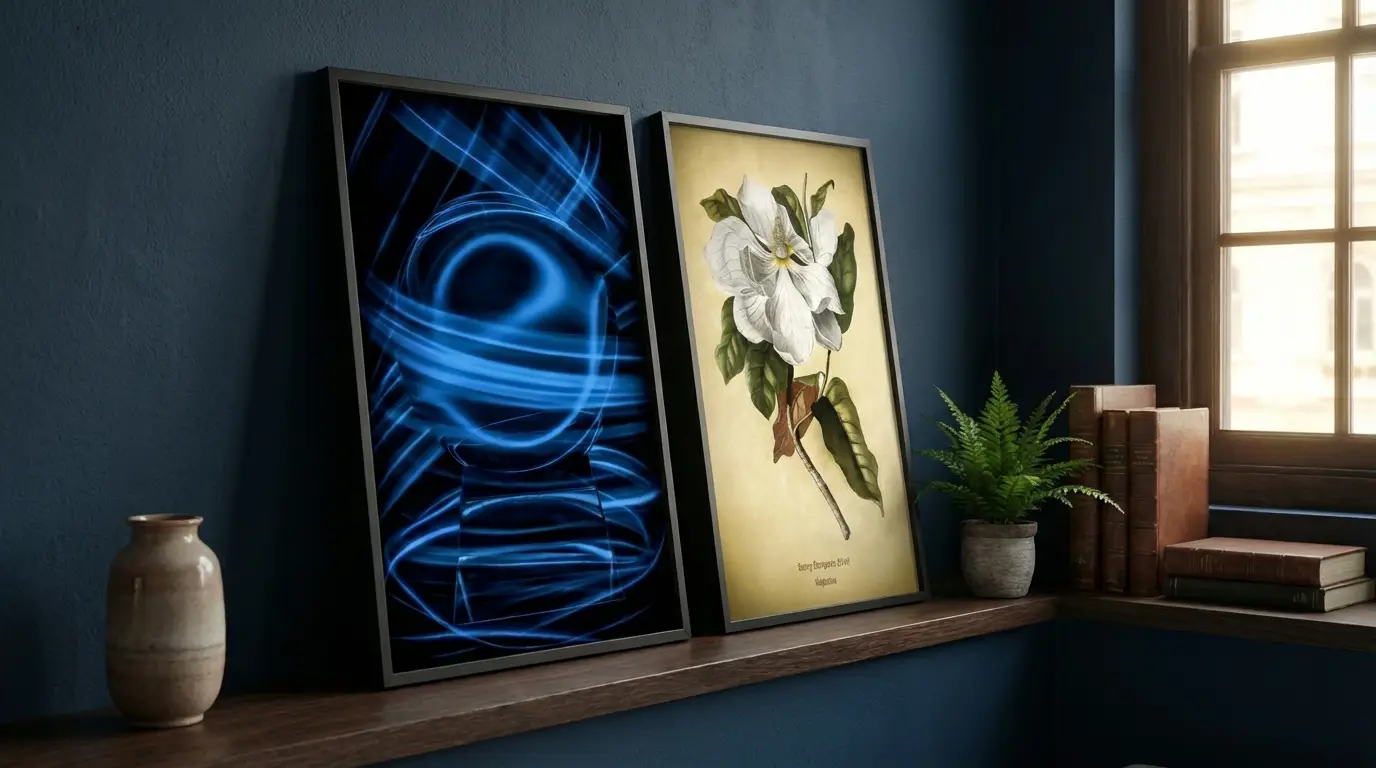
- Works well: Ehret’s magnolia (soft greens, cream) + “Water” (deep blues, black) — the contrast between botanical and abstract can be very sophisticated.
- Works less well: “Poised Tension” (stark black and white) + a bright pop-art print.
Q: Is printable art really as good quality as a store-bought print?
Yes—better, in many ways. Our files are mastered at 300 DPI, the industry standard for gallery-quality printing. When printed professionally on fine-art paper, the result is indistinguishable from a premium store-bought print. The difference is that you control the process, you eliminate waste, and you pay a fraction of the price.
Part 5: Why The Art of Digital Living® matters for your sanctuary
There’s one more layer to this, and it matters more than you might think.
The Art of Digital Living® is our philosophy that art should be:
- Sustainable: No mass production, no inventory, no global shipping. Just a file, printed locally.
- Flexible: Print it at A4 today. Print it at 24″ x 36″ next year when you move to a bigger space. The same file, infinite possibilities.
- Instant: No waiting weeks for delivery. No wondering if it will arrive damaged. Your sanctuary starts now.
But here’s the deeper psychological benefit that most people miss: the act of choosing, printing, and framing your own art is itself a Sanctuary-Seeker practice.
You’re not a passive consumer of someone else’s taste. You’re an active curator of your own environment. You decide the size. You decide the paper. You decide the frame. That agency—that control over your immediate surroundings—is profoundly calming to a nervous system that spends all day being told what to do.
Your bedroom sanctuary isn’t something you buy off a shelf. It’s something you build. And printable art is the tool that lets you build it your way.
Ready to transform your small bedroom?
You now have everything you need: the psychology (Neurodecorating®), the specific prescriptions (four artist-approved prints), and the practical guide (paper, framing, sizing).
Your next step:
Browse our full collection of printable art for Sanctuary-Seekers and find the piece that calls to you.
Or, if you’re not sure which archetype you are, take our free Neurodecorating® quiz to discover whether you’re a Sanctuary-Seeker, Idea-Engine, Deep Thinker, or Curator.