
Introduction
Art has always been fascinated by movement. But for centuries, painters and sculptors were limited by what the human eye could see in a single moment. That all changed in the late 19th century, when a bet about a galloping horse led to one of the most significant breakthroughs in visual history.
The capture of motion in art was revolutionized by Eadweard Muybridge in 1872. He used a series of cameras with fast shutters to prove that a galloping horse lifts all four hooves off the ground at once. This discovery didn’t just change science; it inspired a new generation of artists, including Marcel Duchamp, whose 1912 painting Nude Descending a Staircase fractured the human form to show the blur of movement.
Today, digital artists like Michael Paul Bennett and Duncan Young are continuing this legacy. By using 3D rendering, fractal mathematics, and AI, they are creating dynamic abstract wall art that captures motion in ways Muybridge could only have dreamed of.
The Historical Breakthrough: Muybridge and Duchamp
To understand modern fluid motion art, you have to understand the pioneers.
Eadweard Muybridge (1830–1904)
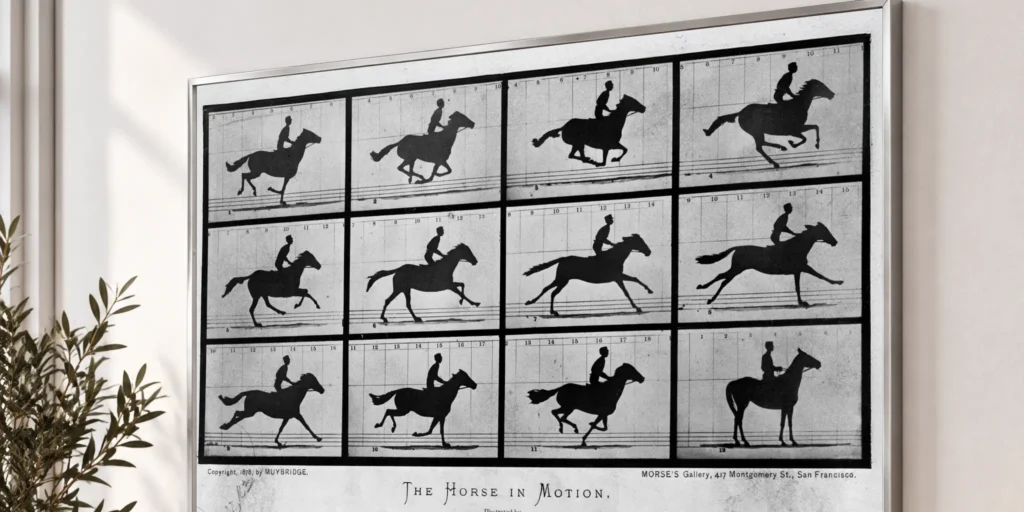
Muybridge was a British photographer working in America. In 1872, he was hired by Leland Stanford (the founder of Stanford University) to settle a bet: does a racehorse ever have all four hooves off the ground simultaneously?
At the time, cameras were too slow to capture a fast-moving horse. Muybridge solved this by setting up a row of 12 to 24 cameras along a track, each triggered by a tripwire as the horse passed. The resulting sequential photographs, known as The Horse in Motion, proved definitively that the horse did lift all four hooves during its stride.
This breakthrough was revolutionary. For the first time, humans could see the mechanics of motion that were previously invisible. Muybridge went on to publish Animal Locomotion (1887), a massive study of humans and animals in motion that remains a foundational text for artists and animators.
Marcel Duchamp (1887–1968)
Muybridge’s sequential photography directly influenced the European avant-garde. In 1912, French artist Marcel Duchamp painted Nude Descending a Staircase, No. 2. Inspired by Muybridge’s time-lapse photography and the Futurist movement, Duchamp fractured the figure into overlapping, geometric planes to convey the sensation of continuous motion.
The painting caused a scandal at the 1913 Armory Show in New York, but it is now considered a masterpiece of modern art. Duchamp’s approach—showing the same body in multiple positions simultaneously—is the direct ancestor of the digital techniques used by artists today.
“Learn more about Duchamp’s Nude Descending a Staircase at the Philadelphia Museum of Art“
The Modern Evolution: How Artists Capture Motion Today
Artists no longer need cameras and tripwires to capture motion. They use software. Here is how three distinct technological eras are being used to create dynamic art today.
1. Michael Paul Bennett: Capturing the Invisible Forces (Digital Fluid Dynamics)
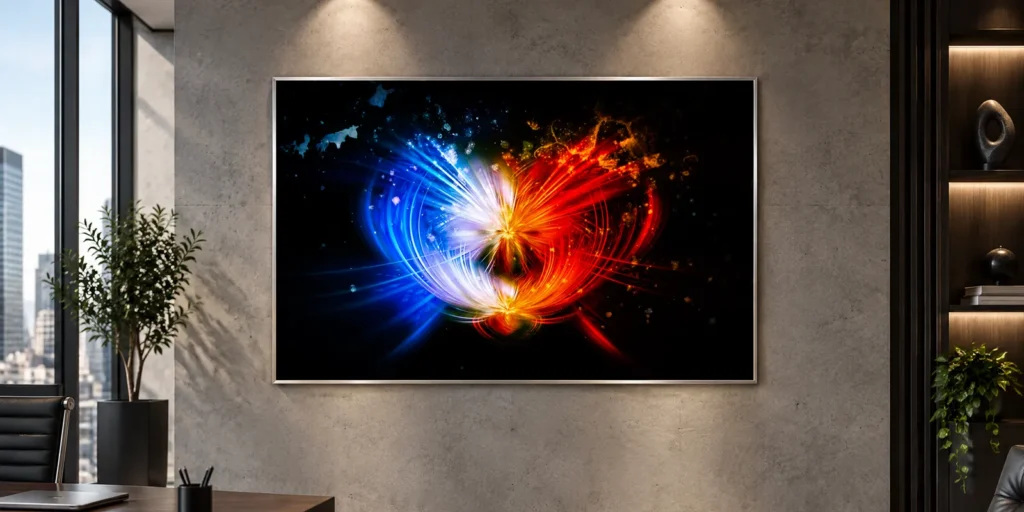
If Muybridge froze motion, Michael Paul Bennett liquifies it. In pieces like “Heaven and Hell”, Michael uses digital layering techniques—specifically Mezzotint and Twirl filters in Adobe Photoshop—to create a visual representation of pure, flowing energy.
Unlike a photograph of a moving object, Michael captures the motion of energy itself. The result is a piece of dynamic abstract wall art that feels like it is constantly in motion, even when standing still. It is a modern evolution of Muybridge’s original goal: to show the invisible forces that govern our world.
2. Duncan Young: The Evolution of the Digital Artist
Duncan Young represents the modern artist’s journey through technology. His work spans three distinct eras of digital creation, showing a mastery of every tool available to the modern creative.
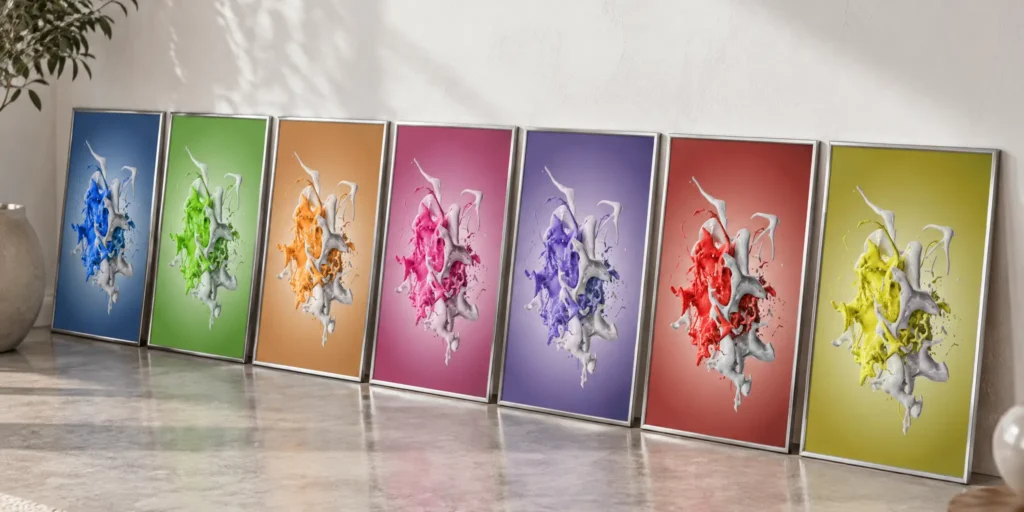
The Splash Collection (3D Physics)
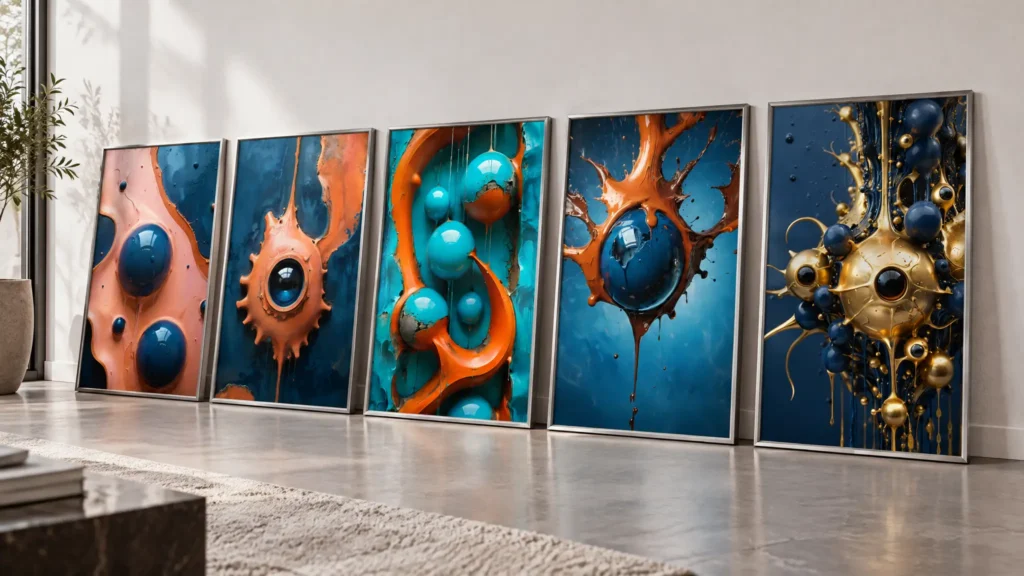
Created using 3D modeling software like Blender, the Splash Collection captures the physics of liquids frozen in time. It is the digital equivalent of Muybridge’s instantaneous photography—capturing the chaotic, beautiful moment of a splash with mathematical precision. Each of the nine pieces in this collection is a study in controlled chaos.
Smoke (Fractal Exploration)
For “Smoke”, Duncan utilized Mandelbulber, a software that explores 3D fractal environments. Fractals are mathematical shapes that repeat infinitely at smaller scales. Here, the motion is not physical but algorithmic. It is the motion of code unfolding in space—a digital nebula that represents the limitless nature of mathematical art.
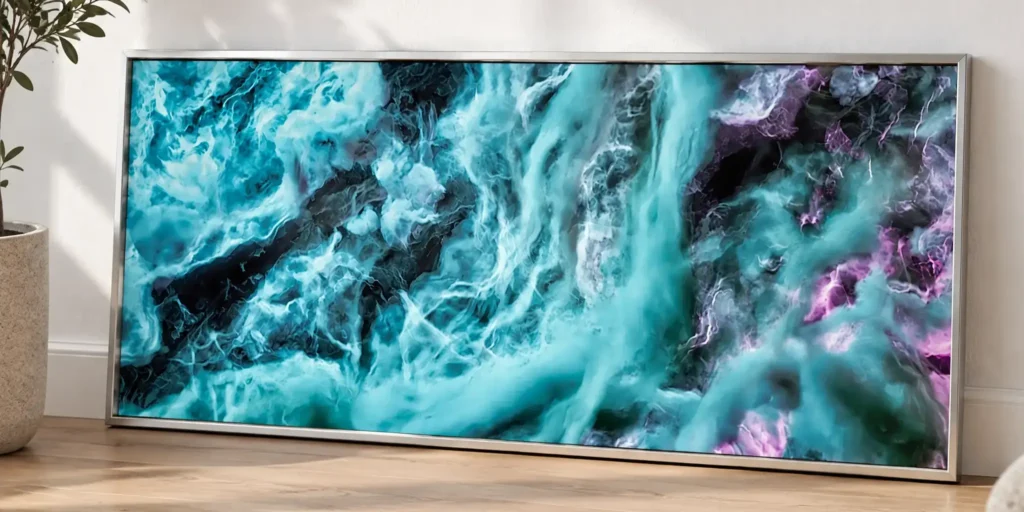
The Irresistible Collection (AI Generation)
Finally, in The Irresistible Collection, Duncan embraces the newest tool in the artist’s arsenal: AI. By guiding generative algorithms, he creates forms that are entirely new. It is the evolution of the artist from a creator of shapes to a director of digital intelligence. This collection shows how AI can be used to capture organic, flowing movement that feels both alien and deeply natural.
Why This Matters for Your Home
Adding a piece of dynamic motion art to your space does more than fill a wall. It creates a sense of energy and flow. Whether you are looking for the explosive fluid dynamics of Michael Paul Bennett or the 3D realism of Duncan Young’s Splash Collection, you can now own a piece of art that continues to move, even when standing still.
These pieces are perfect for:
-
Modern living rooms needing a focal point with energy.
-
Home offices where creativity and momentum are essential.
-
Corporate spaces that want to project innovation and forward-thinking design.
Your Neurodecorating® Prescription:
Dynamic, motion-filled art isn’t just visually striking; it serves a psychological purpose. For the Idea-Engine, the fluid dynamics of Michael Paul Bennett’s work provide a constant source of creative momentum. For the Deep Thinker, Duncan Young’s fractal mathematics offer infinite details to explore. By choosing art that reflects movement, you can energise a space and break through creative blocks.
Own a Piece of the Evolution
From a horse in 1872 to AI-generated fractals in 2026, the goal remains the same: to capture the beauty of movement. Explore our collection of dynamic art prints and bring a sense of motion into your home.
Explore the Duncan Young Collection
Explore the Luminous Art Collection by Michael Paul Bennett